Choosing a light fitting for your dining room isn’t just about having enough brightness to see your food. The right fixture sets the tone for every meal, conversation, and gathering in that space. Whether you’re renovating an entire dining room or simply swapping out an outdated chandelier, understanding your options and what makes a fixture work for your specific layout will save you time, money, and regret. This guide walks you through the essentials, from why lighting matters in a dining room to the practical steps for selecting and installing the perfect fixture for your home.
Table of Contents
ToggleKey Takeaways
- A light fitting for a dining room should balance task, ambient, and accent lighting to create layered illumination that enhances both functionality and ambiance.
- Choose fixture types based on ceiling height: chandeliers for 8–10 feet, semi-flush for 8-foot ceilings, and flush mounts for lower spaces.
- Size your light fitting by subtracting 12 inches from your table’s longest dimension to find the ideal fixture diameter, then hang it 30–36 inches above the tabletop.
- Install your dining room light fixture with warm-white LED bulbs (2700K–3000K) at 2,000–3,000 lumens for energy efficiency and flattering illumination.
- Match your fixture’s finish with wall sconces and decor to maintain cohesive styling throughout the room, and always verify your electrical box and wiring before installation.
- Plan clustered pendant lights (three to five) over tables 48 inches or longer to improve light distribution and achieve a modern aesthetic.
Why Dining Room Lighting Matters
Dining room lighting does far more than illuminate the table. It creates ambiance, influences how food and faces look, and sets the emotional temperature of the entire room. Poor lighting can make a beautiful meal unappetizing and turn a dinner party awkward. Conversely, well-designed lighting transforms an ordinary dining space into somewhere people actually want to linger.
The right fixture balances three lighting functions: task (seeing your food clearly), ambient (general room brightness), and accent (highlighting architectural features or decor). Most dining rooms need a primary overhead fixture paired with secondary lighting, wall sconces, a buffet lamp, or dimmable controls, to create layered illumination. A single harsh ceiling light or an under-powered fixture forces diners to eat in gloom or rely on supplementary lamps that look pieced together.
Types of Dining Room Light Fixtures
Chandeliers and Pendant Lights
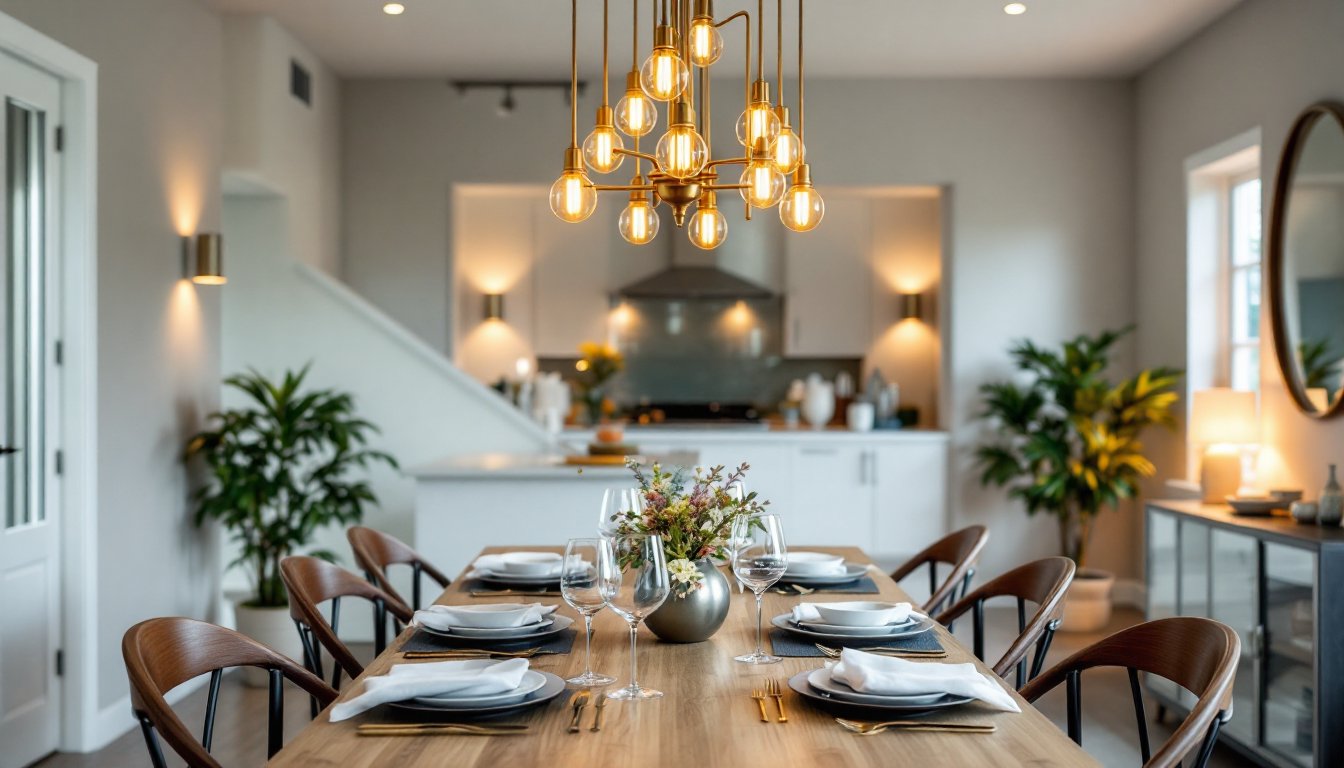
Chandeliers are the traditional anchor for formal dining rooms. They hang from the ceiling via a chain or rod and distribute light through multiple arms or bulbs. A quality chandelier becomes a statement piece, the room’s focal point when you enter. Pendant lights, by contrast, are smaller, often single-bulb fixtures suspended by a cord or rod. They’re more versatile than chandeliers and work well in modern or transitional spaces. Unlike a chandelier, a pendant light can be repeated in clusters (typically three to five over a long table) for more contemporary styling.
Both chandeliers and pendant lighting cast dramatic shadows and create visual interest. But, they require adequate ceiling height, ideally at least 7 feet from the fixture’s bottom to the tabletop, or 8–10 feet for a formal chandelier. If your dining room ceiling is lower, a flush or semi-flush fixture is a better choice. When it comes to style, contemporary dining room lighting trends toward minimalist designs, while traditional homes often favor ornate chandeliers with crystal or brass details.
Flush Mount and Semi-Flush Options
Flush mount fixtures sit directly against the ceiling, making them ideal for rooms with 8-foot ceilings or lower. They’re also practical in dining areas where you don’t want dramatic visual weight overhead. Semi-flush fixtures drop 4–8 inches from the ceiling, a middle ground that adds some decorative presence without overwhelming a modest ceiling height.
Flush and semi-flush options come in dozens of styles: industrial metal, frosted glass, wooden frames, and minimalist geometric designs. They’re typically easier to install than a chandelier and work well with slim recessed lighting or accent wall sconces. The trade-off is subtlety, these fixtures don’t command a room the way a chandelier does. If you want a decorative touch without the drop, pair a semi-flush fixture with accent lighting accessories like table lamps or a wall-mounted display shelf light.
Key Factors to Consider When Selecting a Fixture
Sizing and Placement
Size matters more than most people realize. A fixture that’s too small looks lost above a large table: one that’s too large can feel oppressive and block sight lines across the table. A common rule is to subtract 12 from the table’s longest dimension (in inches) to get the recommended fixture diameter. For example, a 4-foot-wide table works well with a 36-inch (3-foot) fixture. This is a starting point, your room’s proportions, ceiling height, and aesthetic preference all play a role.
Placement requires precision. The center of the fixture should hang directly above the center of the table, 30–36 inches above the tabletop for pendants and chandeliers, or lower if the fixture has an open design that doesn’t block sight lines. If your table is 48 inches or longer, consider clustering three to five smaller pendants instead of one large fixture for better light distribution and a modern aesthetic.
Beyond the table, consider your room’s overall layout. A long, narrow dining room benefits from fixtures positioned along the room’s axis. If you’re installing an outdoor extension (say, a patio dining area), explore chrome pendant options or weatherproof fixtures designed for damp environments. For inspiration on balancing ambient and accent lighting, explore antique lighting styles, many traditional designs layer fixtures beautifully.
Bulb type and wattage matter too. LED bulbs are now standard for dining, they’re energy-efficient, dimmable (if you choose the right fixture), and come in warm color temperatures (2700K–3000K) that flatter skin tones and food. Aim for 2,000–3,000 lumens for a primary dining fixture in an average room: dimmers let you adjust brightness for different moods. Always check the fixture’s maximum wattage and bulb type before buying bulbs: mismatching can void warranties or create fire hazards.
Color temperature and finish matter for aesthetics. Brass or warm bronze finishes pair naturally with warm-white LED bulbs and traditional furnishings. Brushed nickel and chrome work with contemporary or industrial decor. Mismatched finishes, say, a chrome fixture with brass wall sconces, can look scattered. Stick to one or two finishes throughout the room for a cohesive look.
Installation Tips and Best Practices
Before you buy a fixture, confirm your existing ceiling box and wiring are adequate. Most dining room fixtures hang from a standard 4-inch electrical box recessed into the ceiling. If your ceiling box is older or damaged, you may need to install a new one, a job that typically requires working inside the ceiling cavity and shutting off power to that circuit. If you’re not comfortable with electrical work, hire a licensed electrician. Codes vary by jurisdiction, but most areas require a permitted electrician for ceiling fixture installation if new wiring or structural changes are involved.
When you’re ready to install, gather basic tools: a voltage tester, wire strippers, wire nuts, a wrench or pliers, a level, and a step ladder. Follow the fixture manufacturer’s instructions exactly, they include wiring diagrams specific to your model. Most fixtures arrive with a mounting bracket, rods or chains, and pre-attached wires. Always turn off power at the breaker and verify the circuit is dead with a voltage tester before touching any wires.
If the existing fixture’s mounting height isn’t ideal, you can adjust the chain or rod length. Many fixtures allow you to remove or add chain links. For heavily hung fixtures like ornate chandeliers, a second person makes the job much safer and easier. They can hold the fixture steady while you secure the mounting hardware and make electrical connections.
Once installed, test all bulbs and check that the fixture is level and secure. If the fixture swings or wobbles, tighten the mounting bolts. For additional styling inspiration and layered lighting ideas, professional resources like House Beautiful offer detailed ambient and accent lighting guides. If you want to explore pendant lighting for a living room or other spaces, similar principles apply, appropriate scale, height, and finish consistency are universal.
Final Thoughts
Selecting the right dining room light fixture comes down to understanding your space, knowing the fixture types available, and balancing aesthetics with practicality. Size, placement, bulb type, and finish should all align with your room’s layout and decor. Taking time to measure, plan, and follow installation instructions carefully ensures a fixture that looks intentional and works reliably for years. Whether you choose a statement chandelier, clustered pendants, or a sleek semi-flush design, the goal is creating a room where people want to gather, and that starts with light.