Pendant lights aren’t just for kitchen islands anymore. They’ve become a go-to fixture for living rooms, offering task lighting, ambient glow, and a focal point that elevates the entire space. Whether someone’s reading in a corner chair, highlighting a coffee table, or defining a seating zone, pendants deliver both function and style. The right fixture can transform a flat, forgettable ceiling into something worth looking at. This guide walks through everything needed to pick, place, and install pendant lighting that actually works for a living room.
Table of Contents
ToggleKey Takeaways
- Pendant lighting for a living room provides both task and ambient illumination while serving as a design focal point that elevates the entire space without consuming floor or table space.
- The ideal pendant light size should be one-third to one-half the width of the furniture below it, and positioned 30–36 inches above a coffee table to avoid obstruction while delivering effective task lighting.
- Placement options include centering pendants over a coffee table, flanking sofas with matching pairs, or clustering fixtures at varying heights to define zones in open-concept living rooms.
- Layering pendant lighting with ambient sources (recessed cans or flush mounts), task lighting, and accent pieces creates depth and allows control over mood and functionality through dimmers.
- Choose shade materials and color temperatures strategically: opaque shades for focused light (2700–3000K warm white) and frosted glass for softer ambient effects to match existing décor and lighting.
- Before installation, verify an existing electrical box at your intended placement or consider plug-in swag pendants, and ensure proper ceiling support and dimmer compatibility for safe, flexible operation.
Why Pendant Lights Work Beautifully in Living Rooms
Pendant lights solve two common living room problems: they add task lighting exactly where it’s needed and create visual interest without taking up floor or table space. Unlike recessed cans that wash a room in generic overhead light, pendants draw the eye and define specific areas, a reading nook, a conversation zone, or an accent wall.
They’re especially useful in open-concept layouts where a living room bleeds into a dining or kitchen area. A well-placed pendant helps carve out distinct zones without walls. Plus, they come in every style imaginable, mid-century globes, industrial cages, minimalist drum shades, or bohemian rattan, so they adapt to any aesthetic.
From a practical standpoint, pendants provide downward-focused light that’s perfect for tasks like reading or board games, while many designs also cast ambient light upward or through diffusers. That layered illumination is hard to achieve with table lamps alone. And unlike floor lamps, they don’t clutter walkways or tip over when someone’s wrestling a sectional into place.
Choosing the Right Pendant Light Style for Your Living Room
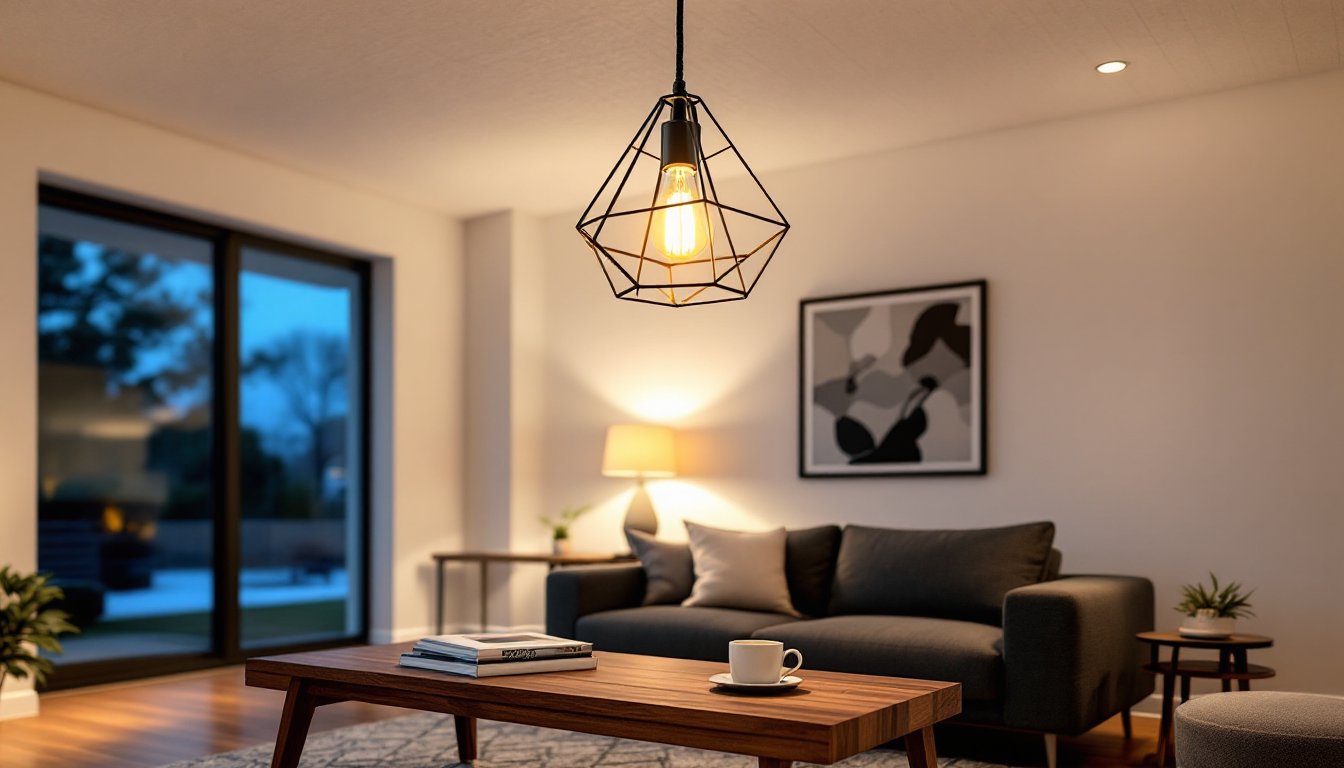
Style matching starts with the room’s existing vibe. A modern living room with clean lines and neutral tones calls for geometric pendants, think matte black metal, brushed brass, or sleek glass globes. Industrial spaces pair well with exposed Edison bulbs in wire cages or aged metal shades that nod to factory lighting.
Traditional and transitional rooms benefit from drum pendants with fabric shades or lantern-style fixtures in bronze or oil-rubbed finishes. These soften the light and blend with classic furniture without competing for attention. For farmhouse or coastal aesthetics, consider woven rattan, natural wood, or matte white ceramic designs that add texture.
Scale matters as much as style. A single oversized pendant (24–30 inches in diameter) makes a bold statement above a coffee table, while a cluster of smaller pendants (8–12 inches each) works beautifully in a corner or flanking a sofa. Designers often showcase creative pendant arrangements that demonstrate how grouping fixtures at varying heights adds depth.
Don’t ignore the shade material. Opaque metal or wood directs light downward for focused task lighting, while frosted glass or linen diffuses light for a softer, ambient effect. Clear glass shows off decorative bulbs but can create glare if placed at eye level.
How to Determine the Perfect Size and Height
Getting the size wrong is the fastest way to make a pendant feel awkward. For a pendant over a coffee table or seating area, aim for a fixture that’s roughly one-third to one-half the width of the table or furniture grouping below it. A 48-inch coffee table pairs well with a 16–24 inch pendant: anything smaller looks lost, and anything larger overwhelms.
Height is equally critical. The bottom of the pendant should hang 30 to 36 inches above a coffee table to avoid head-bumping while allowing the light to illuminate the surface effectively. For seating areas without a table underneath, pendants can hang slightly higher, around 60 to 72 inches from the floor, to clear sightlines and avoid creating a visual barrier.
In rooms with vaulted or cathedral ceilings, pendants need longer downrods or adjustable cables to bring the light down into the living space. A fixture hanging too close to a 12-foot ceiling won’t provide functional light where people actually sit. Adjustable-height pendants with pulley systems or retractable cords offer flexibility.
When clustering multiple pendants, stagger the heights slightly (6–12 inches of variation) for a more dynamic look. Keep the lowest fixture at the recommended height, then work upward. This approach is popular in modern living room design where asymmetry adds visual interest.
Best Placement Ideas for Living Room Pendant Lights
The most common, and effective, placement is centered over a coffee table. This anchors the seating arrangement and provides task lighting for drinks, remotes, or a book. If the coffee table isn’t centered in the room, center the pendant over the table, not the room itself.
Another smart move: flanking a sofa with two matching pendants instead of traditional table lamps. This frees up end table space and creates symmetry. Hang them 12–18 inches in from each arm of the sofa, roughly 60–66 inches from the floor. Make sure the pendants are on separate switches or dimmers so they can be controlled independently.
For a reading nook or accent chair tucked in a corner, a single pendant provides focused task lighting without the footprint of a floor lamp. Position it slightly forward of the chair’s center so light falls on a book or tablet, not the reader’s head.
In open-concept spaces, pendants can define zones. Hang a pair over a console table behind the sofa to separate the living area from a hallway or dining space. Or use a linear pendant or row of mini-pendants to highlight a feature wall or artwork.
Avoid placing pendants directly in main traffic paths. A fixture hanging at the right height for a table can become a head-banger in a walkway. If the room layout requires a pendant near a passage, go higher or choose a compact design.
Layering Pendant Lighting with Other Light Sources
Pendants work best as part of a layered lighting plan that includes ambient, task, and accent sources. Relying on a single pendant, or any single fixture, leaves a room feeling flat and under-lit.
Start with ambient lighting from recessed cans, flush-mount ceiling fixtures, or track lights. These provide general illumination and fill in shadows. Pendants then add task lighting for specific activities, reading, playing games, or working on a laptop.
Accent lighting comes from wall sconces, picture lights, or LED strips that highlight architectural features or artwork. This layered approach creates depth and lets occupants adjust the mood by switching sources on or off. A dimmer on the pendant circuit adds even more control.
In living rooms with limited ceiling electrical boxes, plug-in pendants with ceiling hooks or swag kits offer flexibility. These aren’t as clean as hardwired fixtures, but they’re easier to install and reposition. Pair them with floor lamps or battery-operated sconces to round out the lighting.
Color temperature matters when layering. Warm white bulbs (2700–3000K) in pendants match the cozy glow of most table and floor lamps, while cooler whites (3500K+) can feel clinical in a living space. Mixing temperatures creates visual discord, so stick to a consistent warmth across all fixtures. Many homeowners integrate decorative lighting strategies to balance function and aesthetics.
Installation Tips and What to Consider Before You Buy
Before buying a pendant, confirm there’s an existing electrical box in the ceiling where it’ll hang. Moving a box or adding a new one requires cutting drywall, running cable, and possibly pulling a permit, especially if it involves new circuits. If there’s no box in the ideal spot, consider a plug-in swag pendant that hangs from a ceiling hook and plugs into a wall outlet.
Most pendant installations are straightforward for someone comfortable with basic electrical work: turn off the circuit breaker, remove the old fixture, connect the pendant’s wires (black to black, white to white, ground to ground), mount the canopy, and install the bulb. Always verify power is off with a non-contact voltage tester before touching any wires.
Heavy pendants (over 50 pounds, rare in residential living rooms) require a ceiling fan–rated box that’s fastened to a structural member, not just drywall. Most pendant fixtures weigh 5–15 pounds and work fine with a standard plastic or metal electrical box.
If the pendant hangs over a sitting area, install it on a dimmer switch. A standard toggle dimmer works with most incandescent and halogen bulbs, but LEDs require a compatible LED dimmer to avoid flickering or buzzing. Check the pendant’s specs, some integrated LED fixtures aren’t dimmable at all.
Chain or cable length is adjustable on most pendants, but downrod fixtures come in fixed lengths. Confirm the rod length before ordering, especially for high ceilings. Some manufacturers sell extension rods separately.
Finally, think about bulb access. A pendant that requires disassembling half the fixture to change a bulb gets annoying fast. Look for designs with easy-access shades or cages. And if the fixture uses specialty bulbs (vintage Edison, mini candelabra base, G9 halogen), buy a few spares, hardware stores don’t always stock them. Proper planning ties into broader lighting solutions for the whole home.
Conclusion
Pendant lighting in a living room is more than a trend, it’s a practical, stylish way to add focused light and define space. With the right size, placement, and style, pendants transform an ordinary ceiling into a design feature. Take the time to measure, plan for layered lighting, and ensure the installation is safe and code-compliant. The result is a room that’s as functional as it is inviting.