Fort Myers homeowners know that outdoor living spaces don’t shut down after sunset. With mild winters and year-round outdoor entertaining, proper landscape lighting extends the usability of patios, pathways, and pool areas while adding security and curb appeal. But Southwest Florida’s intense sun, salty air, and daily afternoon thunderstorms demand fixtures and installation techniques that can handle the climate. This guide walks through fixture selection, placement strategies, and installation methods specific to coastal living, so homeowners can design a lighting system that lasts and performs.
Table of Contents
ToggleKey Takeaways
- Landscape lighting in Fort Myers extends outdoor living spaces year-round while improving security, property value, and curb appeal in Southwest Florida’s tropical climate.
- Choose marine-grade materials like copper, brass, and stainless steel with IP65+ ratings to withstand salt spray, UV exposure, and daily afternoon thunderstorms.
- LED fixtures use 75% less energy than halogen equivalents and run on low-voltage systems (12V or 24V) that DIY homeowners can safely install without permits.
- Strategic placement of path lights every 8–10 feet, uplighting for specimen palms, and motion-activated security fixtures maximizes both functionality and aesthetic impact.
- A typical Fort Myers landscape lighting system costs $800–$1,500 in materials for DIY installation or $2,000–$4,500 with professional installation, with operating costs under $4 monthly for LED systems.
Why Landscape Lighting Matters in Fort Myers
Southwest Florida’s outdoor lifestyle makes landscape lighting more than decoration. It’s a functional upgrade that addresses security, safety, and entertainment needs.
Extended outdoor use is the primary driver. With comfortable evenings nearly year-round, homeowners want to use decks, outdoor kitchens, and pool areas after dark. Proper lighting transforms these spaces from unusable to fully functional.
Security and safety concerns also play a role. Well-lit pathways, driveways, and entry points reduce trip hazards and deter unwanted visitors. Motion-activated fixtures near garage doors and side gates add an extra layer of protection without leaving lights on all night.
Property value gets a measurable boost. Homes with professionally designed lighting systems typically see higher appraisals and faster sales. Buyers in this market expect outdoor amenities, and lighting is part of that package.
Hurricane preparedness is a local consideration. Low-voltage systems are easier to disconnect and protect before a storm than hardwired 120V fixtures. Many Fort Myers homeowners prefer systems they can quickly deactivate and stow when evacuation orders come through.
Popular Landscape Lighting Styles for Fort Myers Homes
Fort Myers architecture leans heavily toward Mediterranean, coastal contemporary, and tropical themes. Lighting styles should complement these aesthetics without clashing.
Path lights are foundational. They line walkways, driveways, and pool decks with low-level illumination. Coastal homes often use fixtures with copper or bronze finishes that develop a natural patina over time. Heights range from 12 to 24 inches, depending on the desired light spread.
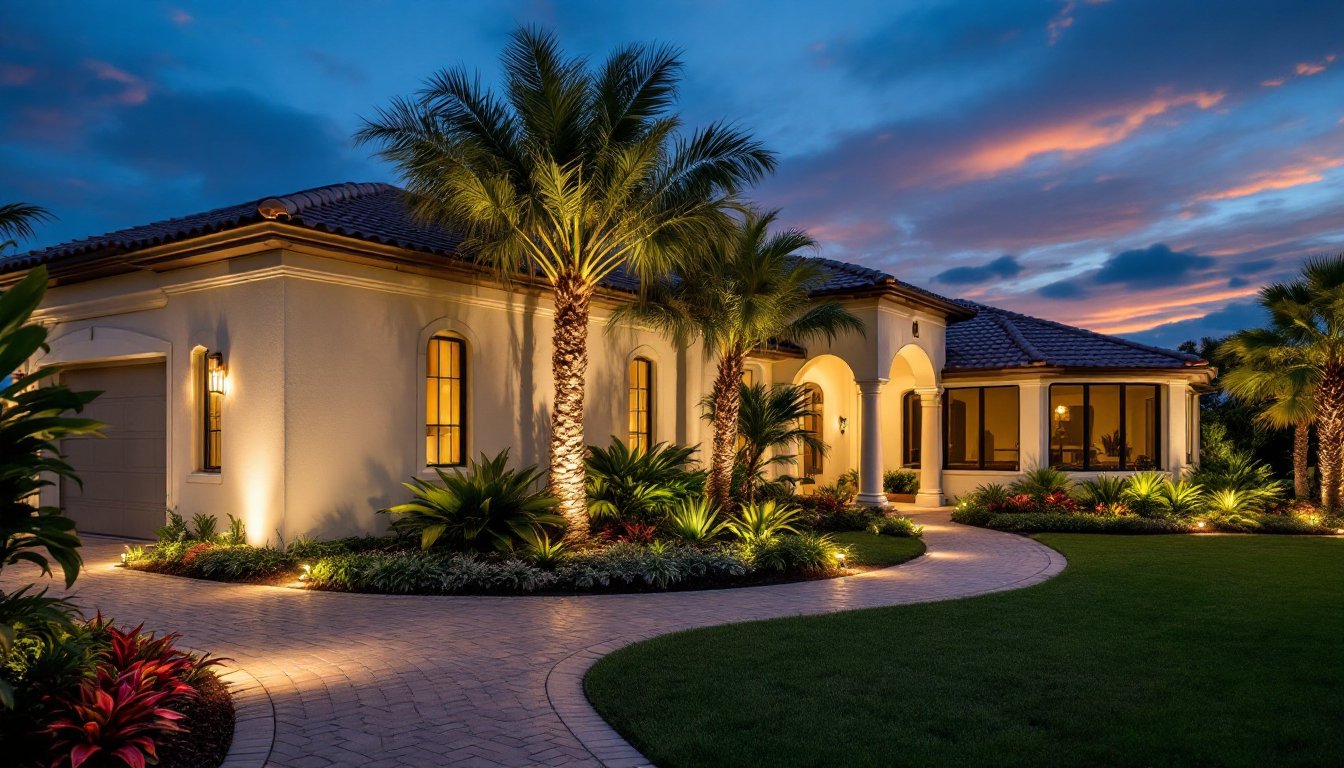
Uplighting highlights architectural features and specimen palms. Narrow beam fixtures (15–30 degrees) placed at the base of a sabal palm or royal poinciana create dramatic vertical wash. For stucco walls or columns, wider floods (60–90 degrees) work better.
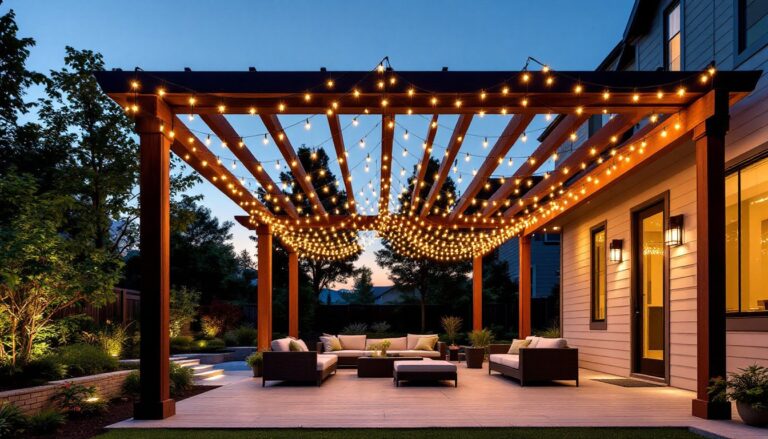
Downlighting mimics moonlight when installed in tree canopies or under eaves. Fixtures with shielded lenses prevent glare and direct light downward onto patios or garden beds. This technique works well for outdoor dining areas where soft, indirect light is preferred.
Deck and step lights are non-negotiable for pool cages and multi-level patios. Recessed fixtures install directly into risers or post caps. Many Fort Myers builders now include these during construction, but retrofit options exist for older homes.
Accent lights focus on water features, sculptures, or specimen plants. Compact LED spots with adjustable heads allow homeowners to change focal points as landscaping matures.
Choosing the Right Fixtures for Southwest Florida’s Climate
Not all landscape lighting survives Fort Myers conditions. Salt spray, UV exposure, humidity, and afternoon storms separate quality fixtures from junk.
Material selection is critical. Copper, brass, and marine-grade stainless steel hold up best. Avoid painted aluminum and plastic housings, they corrode or become brittle within two to three years. Even powder-coated finishes degrade faster here than in drier climates.
IP ratings (Ingress Protection) indicate water and dust resistance. For Southwest Florida, choose fixtures rated IP65 or higher. The first digit (6) means dust-tight: the second (5) means protected against water jets from any direction. Anything lower will fail during summer monsoons.
Gasket and seal quality matters as much as the housing. UV-resistant silicone or EPDM rubber gaskets prevent moisture intrusion. Check that lens covers seat tightly, gaps let in humidity that fogs lenses and corrodes sockets.
Heat dissipation is often overlooked. LED fixtures still generate heat, and trapped heat shortens diode life. Look for designs with ventilated backs or heat-sink fins. Fully sealed fixtures without thermal management often fail prematurely in this climate.
When working with professional installers, verify they stock fixtures designed for coastal environments. Not all suppliers carry marine-grade components.
DIY Landscape Lighting Installation Tips
Low-voltage landscape lighting (12V or 24V) is within reach for most DIYers. Line-voltage systems (120V) require a licensed electrician and permits in Lee County.
Planning the Layout
Start with a scaled site plan. Mark existing plantings, hardscape, and structures. Sketch light placements before buying fixtures. Count total wattage to size the transformer correctly, add 20% buffer beyond calculated load.
Decide on series or hub wiring. Series (daisy-chain) is simpler but causes voltage drop over distance. Hub systems run individual home runs from the transformer, maintaining consistent voltage. For runs over 50 feet, hub wiring performs better.
Transformer Placement
Mount the transformer near a GFCI-protected outdoor outlet. It should be 12–18 inches above grade to avoid flooding. Transformers with photocells and timers automate on/off cycles, manual switches are inconvenient.
Size transformers by total wattage: most residential systems need 150 to 600 watts. Buy a model with multiple taps (12V, 13V, 14V, 15V) to compensate for voltage drop on long runs.
Trenching and Wire Burial
Bury low-voltage cable 6 inches deep minimum. Use direct-burial-rated wire (12-gauge or 14-gauge stranded copper). Solid-core wire is harder to work with and more prone to breakage.
Avoid trenching through root zones of established trees. Route around drip lines when possible. For pathways and driveways, use Schedule 40 PVC conduit to protect cable from shovels and edgers.
Connections
Use waterproof wire connectors filled with dielectric grease. Standard wire nuts fail in this climate. Heat-shrink connectors with solder sleeves are best but require a heat gun.
Test each fixture before backfilling trenches. Troubleshooting buried connections is frustrating and time-consuming.
Safety Gear
Gloves, safety glasses, and closed-toe boots are standard. If working near fire ant mounds (common here), treat them first. Long sleeves help when trenching near saw palmettos or bougainvillea.
Best Locations to Place Landscape Lights Around Your Property
Strategic placement maximizes impact without over-lighting. The goal is accent and function, not floodlit uniformity.
Entry and front walkways should be the priority. Place path lights every 8 to 10 feet along both sides of the walk. If budget is tight, stagger lights on alternating sides. Uplight the front door or porch columns for depth.
Driveways benefit from low bollards or recessed driveway markers at curves and edges. Avoid glare in drivers’ eyes, fixtures should cast light down, not outward.
Pool and patio areas require task lighting for safety and ambient lighting for mood. Recessed step lights on pool decks are code-required in many jurisdictions. Add downlighting in pergola rafters or under eaves for dining areas.
Specimen trees and architectural features make natural focal points. Uplight mature palms from 2 to 4 feet away, angling the fixture to graze the trunk. For feature walls or columns, place fixtures 12 to 18 inches from the base.
Garden beds and water features add secondary interest. Use narrow-beam spots to highlight bromeliads, crotons, or fountain centerpieces. Avoid lighting every plant, select a few key specimens.
Security zones around side gates, AC units, and garage doors benefit from motion-activated floods. These should be separate from decorative lighting to avoid nuisance activation.
Energy-Efficient Options and Cost Considerations
LED fixtures dominate the market for good reason: they last 25,000 to 50,000 hours and use 75% less energy than halogen equivalents. Initial costs are higher, but operating expenses and replacement frequency are far lower.
Wattage per fixture has dropped significantly. Where older halogen path lights used 20 watts, comparable LED models use 3 to 5 watts. Total system wattage for a typical Fort Myers home with 12–18 fixtures often stays under 100 watts.
Color temperature affects ambiance. 2700K to 3000K (warm white) suits most residential landscapes and complements tropical plantings. Cooler temps (4000K+) feel clinical and wash out foliage color.
Solar options work in Fort Myers due to abundant sun, but performance varies. Quality solar path lights with monocrystalline panels and lithium-ion batteries provide 6–8 hours of runtime. Cheap models with NiCad batteries fail within a year. Solar works best for remote areas where trenching is impractical.
Cost Breakdown
Material costs for a DIY low-voltage system serving 12–16 fixtures typically run $800 to $1,500, depending on fixture quality. This includes transformer, cable, connectors, and fixtures. Professional installation adds $1,200 to $3,000 depending on complexity and site conditions.
For accurate local pricing and contractor comparisons, HomeAdvisor and ImproveNet offer cost estimators and vetted installer directories. Costs fluctuate with copper and LED component prices, so get multiple quotes.
Operating costs for a 100-watt LED system running six hours nightly average $2 to $4 per month at current Fort Myers electric rates (around $0.12/kWh). Timer or photocell controls prevent lights from running unnecessarily during daylight.
Conclusion
Landscape lighting in Fort Myers requires climate-appropriate fixtures, thoughtful placement, and proper installation techniques. Homeowners who invest in marine-grade materials and low-voltage LED systems get years of reliable performance with minimal maintenance. Whether tackling a DIY installation or hiring professionals, the key is planning for Southwest Florida’s unique conditions from the start.