Most folks treat bedroom lighting like an afterthought, slap up a ceiling fixture, maybe a lamp or two, and call it done. But here’s the thing: the right mix of fixtures can turn a space from “just okay” for sleep” into a room that works for reading, getting dressed, winding down, and yes, even a little mood-setting. Unlike a garage or mudroom, your bedroom demands lighting that does triple duty: functional when you need it, gentle when you don’t, and attractive around the clock. Getting this balance right doesn’t require an electrician on speed-dial or a designer budget, just a solid understanding of fixture types, layering strategy, and how to match hardware to your room’s style and size.
Table of Contents
ToggleKey Takeaways
- Bedroom lighting fixtures should be layered across three functional levels—ambient, task, and accent—and controlled on separate switches to adapt to reading, dressing, and winding down.
- Warm color temperatures between 2700K–3000K paired with dimmer switches protect sleep quality by preventing melatonin suppression that can occur with bright, blue-heavy overhead fixtures.
- Task lighting requires strategic placement: bedside lamps need 100-watt-equivalent LEDs for reading, sconces should be mounted 60–66 inches high and 36–40 inches apart, and desk areas need 50–75 foot-candles of illumination.
- Bedroom lighting fixtures must match your room’s design style—modern bedrooms suit matte black and geometric shapes, while farmhouse spaces benefit from weathered wood and galvanized metals.
- Maximum fixture diameter should equal your room’s length plus width converted to inches (e.g., a 12×14 room supports a 26-inch fixture), and verify your ceiling junction box weight rating before installation.
Why Bedroom Lighting Matters More Than You Think
Poor lighting in a bedroom doesn’t just make it hard to find matching socks, it can mess with your sleep quality, strain your eyes during late-night reading, and make the whole space feel either too clinical or too cave-like. The National Electrical Code (NEC) doesn’t mandate specific light levels for bedrooms the way it does for stairways or bathrooms, but the Illuminating Engineering Society recommends around 20–30 foot-candles for general tasks and up to 50 foot-candles for close work like reading or applying makeup.
Beyond the numbers, bedroom lighting shapes circadian rhythms. Blue-heavy or overly bright overhead fixtures before bed can suppress melatonin production, making it harder to fall asleep. That’s why dimmer switches and warmer color temperatures (2700K–3000K) have become standard recommendations in sleep-friendly design. On the flip side, insufficient task lighting forces you to crank up overhead fixtures, flooding the room with light when you only need a focused beam.
Finally, there’s resale value and daily livability. A well-lit bedroom with layered fixtures signals thoughtful design to buyers and makes everyday routines, from folding laundry to getting dressed, smoother and less frustrating. You’re not just installing light bulbs: you’re engineering a space that adapts to multiple needs throughout the day and night.
Types of Bedroom Lighting Fixtures to Consider
Overhead and Ceiling Fixtures
Ceiling fixtures are the workhorses of bedroom lighting. Most bedrooms come with a builder-grade flush-mount or semi-flush fixture centered in the room, functional but rarely sufficient on its own. Flush-mount fixtures sit tight against the ceiling (good for rooms with 8-foot ceilings), while semi-flush models drop a few inches and spread light more evenly.
For rooms with higher ceilings (9 feet or more), chandeliers or pendant lights add visual interest without overwhelming the space. When installing a pendant, leave at least 7 feet of clearance from the floor to the bottom of the fixture, more if you’ve got tall family members. If your bedroom lacks overhead wiring, adding a junction box is straightforward but requires opening the ceiling: you’ll want to locate a joist for secure mounting.
Ceiling fans with integrated light kits are popular in warmer climates, but many models produce uneven, flickering light. If you go this route, choose one with a separate downlight and uplight option or add a retrofit LED array designed for fans. Consider incorporating various lighting solutions that can complement the overhead fixture and improve overall room function.
Task Lighting Options
Task lighting puts focused illumination exactly where you need it. Bedside table lamps are the most common, and for good reason, they’re plug-and-play, adjustable, and easy to swap out. Look for lamps with a minimum 100-watt-equivalent LED bulb (actual draw around 15 watts) for reading: anything less will have you squinting.
Wall-mounted swing-arm lamps save nightstand real estate and can be hardwired or plug-in. Install them about 15–20 inches above the mattress top, positioned so the shade’s bottom edge aligns roughly with your shoulder when seated. This keeps light out of your eyes while directing it onto your book or device.
For dressing areas or vanities in the bedroom, sconces flanking a mirror provide shadow-free lighting for grooming tasks. Mount them at eye level (about 60–66 inches from the floor) and space them 36–40 inches apart for even coverage. Use frosted or opal glass shades to diffuse the light and prevent harsh glare.
If your bedroom doubles as a workspace, a desk lamp with adjustable arm and head is non-negotiable. Clamp-on models work well for floating shelves or tight corners. Aim for 50–75 foot-candles at the desk surface, roughly what a good 800-lumen LED provides at 18 inches.
Accent and Ambient Lighting
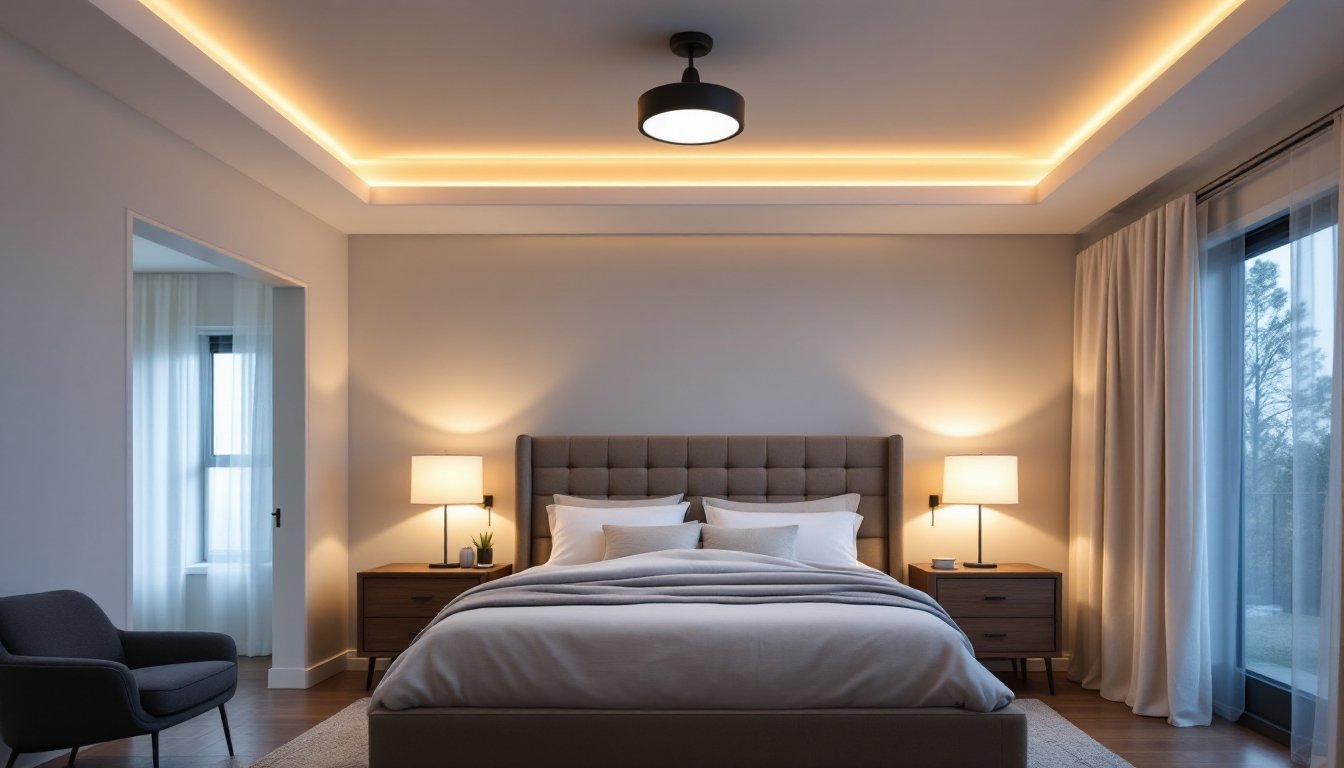
Accent lighting adds depth and personality without contributing much to functional illumination. LED strip lights installed under floating nightstands, behind headboards, or along crown molding create a soft glow that’s perfect for late-night navigation or movie watching. Most strips run on 12V or 24V systems and can be cut to length at designated points: look for models with a high CRI (90+) to avoid washed-out colors.
Picture lights or small puck lights can highlight artwork or architectural details, useful in primary suites or larger bedrooms where you want to draw the eye. Install them about 12–18 inches above the frame and aim downward at a 30-degree angle.
Floor lamps with torchiere or arched designs bounce light off the ceiling for soft, indirect ambient lighting. They’re especially helpful in corners that overhead fixtures can’t reach. Pair them with smart bulbs or plug-in dimmers to adjust intensity throughout the evening. Thoughtfully chosen decorative lighting can serve dual purposes, providing both style and supplementary illumination.
How to Layer Lighting in Your Bedroom
Layering means combining ambient, task, and accent lighting on separate circuits or switches so you can dial in the right mood and function for any situation. Most bedrooms fail here, they rely on a single overhead fixture controlled by a single switch, leaving you with an all-or-nothing lighting scenario.
Start with your ambient layer: the overhead fixture or ceiling fan light. This should provide general illumination for cleaning, changing sheets, or finding that missing shoe. Pair it with a dimmer so you can knock the intensity down to 20–30% in the evening. If you’re adding a new fixture to an existing junction box, verify the box is rated for the fixture’s weight, ceiling fans and heavy chandeliers require a fan-rated or 50-pound-rated box.
Next, add your task layer: bedside lamps, swing-arms, or sconces. Put these on a different circuit or use plug-in dimmers so they operate independently of the overhead. This lets one partner read while the other sleeps, a surprisingly common flashpoint in shared bedrooms. If you’re building or remodeling, consider adding switched outlets at bedside so lamps can be controlled from the door and the bed (three-way switching).
Finally, bring in your accent layer: LED strips, floor lamps, or small puck lights. These should be the dimmest and most adjustable, serving primarily as mood lighting or nighttime navigation. Smart plugs or smart bulbs make it easy to automate this layer, set them to turn on at 10% brightness after sunset or trigger them with motion sensors for middle-of-the-night bathroom trips.
Don’t forget about color temperature. Mixing 2700K warm white with 5000K daylight bulbs in the same room looks disjointed. Stick to 2700K–3000K across all fixtures for a cohesive, restful feel. If you want cooler light for morning routines, use tunable smart bulbs rather than installing mismatched fixtures. Planning bedroom decor design around lighting layers ensures that fixtures, finishes, and furniture work together harmoniously.
Choosing Fixtures Based on Your Bedroom Style
Your fixture finish, shape, and material should echo the room’s overall design language, not fight it. In a modern or contemporary bedroom, look for fixtures with clean lines, matte black or brushed nickel finishes, and geometric shapes. Pendant lights with exposed Edison bulbs or minimalist drum shades fit well here. Skip ornate crystals or antique brass unless you’re intentionally mixing styles. Many modern design concepts emphasize the interplay between fixture form and room architecture.
For traditional or transitional spaces, consider chandeliers with subtle detailing, oil-rubbed bronze or aged brass finishes, and fabric or frosted glass shades. Wall sconces with candle-style bulbs or swing-arms in classic silhouettes complement wood furniture and crown molding. Avoid ultra-modern LED strips or industrial cage pendants, they’ll clash.
Farmhouse and rustic bedrooms pair beautifully with fixtures that have weathered wood accents, galvanized metal finishes, or industrial-style cages. Barn-style sconces, wagon wheel chandeliers (used sparingly), and wire-basket pendants all work. For those pursuing this aesthetic, exploring farmhouse lighting options can yield fixtures that combine function and charm. Make sure finishes match other hardware in the room, door handles, curtain rods, picture frames, for a cohesive look.
In minimalist or Scandinavian bedrooms, less is more. Choose a single statement fixture, like a sculptural pendant or oversized floor lamp, and keep everything else understated. White or light wood finishes, simple globe shades, and hidden LED strips work best. Avoid clutter: every fixture should earn its place functionally and visually. Integrating smart lighting accessories like wireless dimmers or motion sensors keeps controls minimal and unobtrusive.
Bohemian or eclectic bedrooms give you the most freedom: mix metals, layer textures, and combine vintage finds with modern tech. Rattan pendants, beaded chandeliers, Moroccan lanterns, and colorful fabric shades all play well here. Just keep the color temperature consistent, boho doesn’t mean chaotic. For additional inspiration on achieving design balance, explore how leading designers marry eclectic fixture choices with cohesive room palettes.
Finally, scale matters. A king bed in a 14×16 room can handle a 24-inch chandelier: a twin in a 10×10 space maxes out around 16 inches. As a rule of thumb, add the room’s length and width in feet, then convert to inches, that’s your maximum fixture diameter. And don’t forget the ceiling junction box’s weight rating, lightweight resin or aluminum fixtures are safer bets if you’re unsure of your box’s capacity.