Solar-powered outdoor lighting has evolved from dim novelty stakes to legitimate landscape illumination. Today’s panels capture more energy, LEDs run longer, and battery tech holds charges through cloudy stretches. Homeowners installing solar fixtures skip trenching, wiring, and electrical permits while cutting long-term energy costs to zero. Whether lighting a pathway, deterring porch pirates, or stringing ambiance across a deck, solar options now match, and sometimes exceed, the performance of low-voltage AC systems. This guide walks through how the technology works, where it excels, and what to look for when shopping.
Table of Contents
ToggleKey Takeaways
- Solar-powered outdoor lighting eliminates installation costs and electrical permits by requiring no wiring, trenching, or professional setup, making it ideal for remote areas like gate posts and garden beds.
- Modern solar outdoor lighting uses efficient photovoltaic panels (18–22% for monocrystalline), lithium-ion batteries, and smart charge controllers to deliver 8–12 hours of runtime with minimal maintenance.
- Panel placement is critical: ensure at least six hours of unobstructed direct sunlight and aim panels south in the Northern Hemisphere to maximize energy capture and avoid 50% output loss from shading.
- Choose solar lights based on application—pathways need 10–50 lumens at warm white (3000 K), while security floods require 600–1,200 lumens at daylight color temperature (4000–5000 K) with motion sensors.
- Prioritize fixtures with IP65+ ingress protection, metal housings, monocrystalline panels, and replaceable batteries to ensure durability beyond one season and maintain performance across freeze-thaw cycles and coastal environments.
- Solar outdoor lighting reduces residential exterior electricity use by up to 20%, lowering grid reliance and environmental impact while providing zero operating costs over the fixture’s 20+ year lifespan.
Why Solar-Powered Outdoor Lighting Is a Game Changer for Your Home
The biggest draw is zero operating cost. Once a solar fixture is mounted, the sun handles the rest, no meter spin, no GFCI circuits to install. That makes them ideal for spots far from existing outlets: gate posts, shed corners, fence lines, and garden beds.
Installation takes minutes instead of hours. There’s no need to call an electrician, pull permits, or bury conduit 18 inches deep per National Electrical Code (NEC) Article 300.5. Stick the stake, mount the bracket, aim the panel south (or wherever gets six hours of direct sun), and you’re live.
Maintenance is minimal. Polycrystalline or monocrystalline silicon panels last 20+ years. LEDs sip power, typically 0.5 to 3 watts per fixture, so battery packs (usually lithium-ion or NiMH) can store enough juice for 8–12 hours of runtime. Clean the panel twice a year, swap the battery every 2–3 years, and the lights keep working.
Flexibility is another win. Rearrange pathway lights as your garden matures, move a motion sensor when you add a gate, or take decorative strings with you when you move. No patching stucco or capping abandoned junction boxes.
The environmental angle matters, too. Outdoor lighting accounts for roughly 20% of residential exterior electricity use. Shifting to solar drops that chunk to zero and reduces reliance on grid power, especially in areas still burning coal or natural gas for generation.
How Solar Outdoor Lights Actually Work
At the core sits a photovoltaic (PV) panel, typically a 2-watt to 6-watt polycrystalline or monocrystalline silicon wafer encased in tempered glass or polycarbonate. When photons hit the silicon, they knock electrons loose, generating direct current (DC).
That DC flows into a rechargeable battery pack, usually a 3.2 V lithium iron phosphate (LiFePO₄) cell or a 1.2 V nickel-metal hydride (NiMH) AA bank. Battery capacity ranges from 600 mAh in budget stakes to 2,200 mAh in security floods. Higher capacity means longer runtime and better performance during cloudy spells.
A charge controller sits between panel and battery, preventing overcharge during sunny days and deep discharge at night. Cheap fixtures skip this component and fail within a season: quality units include pulse-width modulation (PWM) or, in premium models, maximum power point tracking (MPPT) controllers that squeeze 10–20% more energy from the panel.
At dusk, a photoresistor or light sensor detects dropping lux levels and triggers the LED array. Most fixtures turn on automatically at <10 lux and off at dawn. Motion-sensor models add a passive infrared (PIR) detector that switches the light to full brightness when it senses body heat within a 15–30-foot cone.
The LED module, usually surface-mount diodes (SMDs) rated 3000 K to 5000 K color temperature, draws power from the battery. Typical output ranges from 10 lumens for accent stakes to 1,200 lumens for security floods. Runtime depends on battery capacity and LED draw: a 1,000 mAh battery powering a 1-watt LED will theoretically run 3–4 hours (accounting for conversion losses and voltage drop).
Panel placement is critical. Shading from eaves, tree branches, or fences cuts output dramatically, even 10% shade can reduce charge by 50% on series-wired cells. Aim panels south in the Northern Hemisphere, angled at your latitude (roughly 30–40° in the continental U.S.). Adjustable brackets help if you’re mounting on a wall or post that doesn’t face true south.
Types of Solar Outdoor Lighting for Every Space
Pathway and Landscape Solar Lights
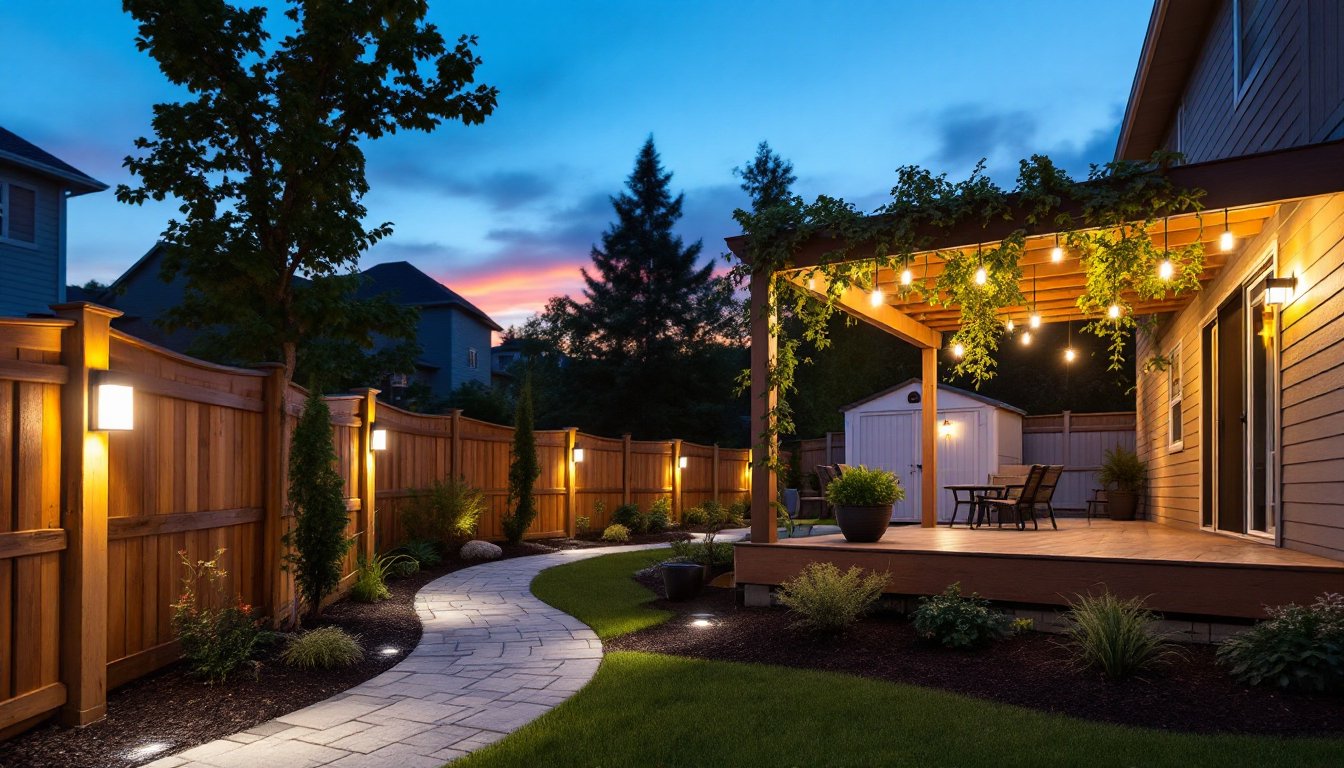
These are the workhorses: 6- to 12-inch stakes with top-mounted panels and downward-facing LEDs. Output typically runs 5–25 lumens per fixture, enough to mark a walkway edge or highlight a shrub without washing out the night sky.
Most use 0.5- to 1-watt panels and NiMH AA batteries. Expect 6–10 hours of runtime after a full sunny day. Spacing them 6–8 feet apart along a path provides continuous wayfinding without light pollution.
Better models include die-cast aluminum or stainless-steel housings with IP65 or IP67 ingress protection, meaning they’ll survive sprinkler overspray and heavy rain. Avoid all-plastic stakes in climates with freeze-thaw cycles, UV and thermal stress crack them within two seasons.
For landscape beds, consider spotlights with ground spikes. These put out 50–150 lumens and work well uplighting a tree trunk or accent boulder. Look for adjustable heads so you can aim the beam as plants grow. Many designers featured on Gardenista layer path lights with spotlights for depth and dimension.
Solar Security and Motion-Sensor Lights
Dual-head or quad-head floodlights with PIR sensors deliver 600–1,200 lumens on detection, enough to light a driveway apron or side gate. Panel wattage jumps to 5–10 watts, and battery packs use LiFePO₄ cells with 2,000+ mAh capacity.
Detection range and sensitivity matter. Quality units sense motion 20–30 feet out and let you dial sensitivity (to ignore cats and raccoons) and duration (10 seconds to 5 minutes). Some include dusk-to-dawn dimming: the light runs at 10–20% brightness all night, then jumps to 100% on motion. This hybrid mode balances security and battery life.
Mounting height affects coverage. Install 8–12 feet above grade with the sensor angled downward at 15–25°. Too high and you miss motion: too low and every passing squirrel triggers the flood. Use stainless or galvanized hardware, plastic clips fail in wind.
Check local ordinances. Some municipalities limit outdoor fixture brightness to 3,000 lumens and require shielding to prevent glare on neighboring lots. If your HOA or code official balks, motion-activated solar floods usually pass because they’re not continuous.
Decorative Solar String and Accent Lights
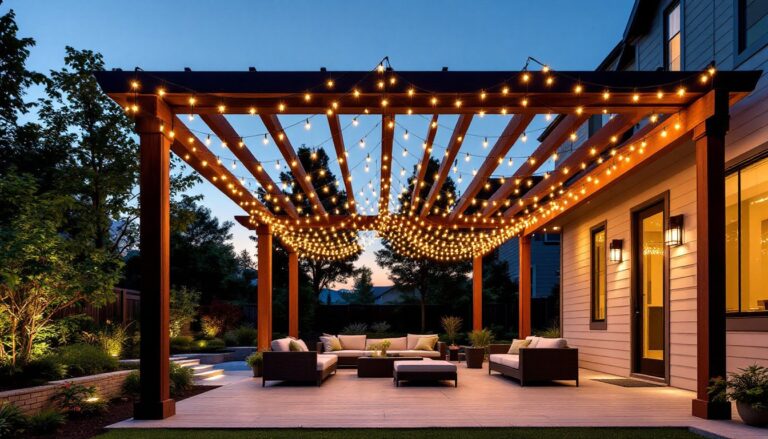
Solar string lights, globe, Edison, or fairy-style, add ambiance to decks, pergolas, and patios without running extension cords. Panel sizes range from 2 to 5 watts, supporting 10 to 50 LEDs over 15 to 50 feet of wire.
Most strings run warm white (2700–3000 K) at 1–5 lumens per bulb. That’s mood lighting, not task lighting. For dining or grilling, supplement with a brighter outdoor track lighting circuit or a portable solar lantern.
Rated for outdoor use means IP44 minimum (splash-resistant): IP65 is better if your pergola doesn’t have a roof. Copper or vinyl-coated wire holds up better than bare copper, which oxidizes and turns green.
Solar deck post caps and step lights are tidy solutions for railings and stair risers. They typically use 1-watt panels, output 5–15 lumens, and mount with screws or adhesive pads. Make sure cap dimensions match your post size, standard nominal 4×4 posts actually measure 3.5″ × 3.5″, and a cap sized for true 4″ will wobble.
For special projects like DIY lanterns or custom garden art, modular solar kits with separate panels, batteries, and LED strips offer flexibility. Platforms like Instructables host dozens of solar lighting builds, from mason-jar path markers to pallet-wood lamppost conversions.
Choosing the Right Solar Lights: Key Features to Consider
Panel wattage and efficiency set the ceiling for performance. Monocrystalline panels convert sunlight at 18–22% efficiency: polycrystalline runs 15–18%. For year-round reliability in northern latitudes or partly shaded sites, spend the extra dollar on mono.
Battery type and capacity determine runtime. Lithium-ion and LiFePO₄ hold more charge in smaller packages and tolerate deeper discharge cycles than NiMH. Capacity is listed in milliamp-hours (mAh), higher is better. A 2,000 mAh pack running a 1-watt LED (roughly 300 mA at 3.2 V) can theoretically deliver 6+ hours, accounting for inefficiencies.
Replaceability matters. Fixtures with removable, standard-size batteries (18650 cells, AA, AAA) let you swap in fresh packs when capacity fades. Proprietary packs often mean tossing the entire fixture after three years.
Lumen output and color temperature should match the task. Pathways: 10–50 lumens, 3000 K warm white. Security: 600–1,200 lumens, 4000–5000 K daylight. Accent and decorative: 5–100 lumens, 2700–3000 K warm white. Check the product spec sheet, some manufacturers inflate “equivalent wattage” claims without listing actual lumens.
Build quality and ingress protection (IP rating) separate one-season junk from decade-long performers. IP65 (dust-tight, water-jet resistant) is the baseline for unprotected installations. Metal housings (aluminum, stainless, powder-coated steel) outlast plastic. Tempered glass or polycarbonate lenses resist yellowing and impact better than acrylic.
Adjustability and mounting options add versatility. Swiveling panels let you chase the sun as seasons change the angle. Removable stakes convert to wall brackets. Separate panels connected by a 10–15-foot cable allow you to place the light in shade while the panel basks in sun, useful under eaves or dense canopy.
Certifications and warranties signal manufacturer confidence. Look for FCC (electromagnetic interference), CE (European safety), and RoHS (no hazardous substances). A two-year warranty is standard: premium brands offer three to five.
Avoid fixtures with no listed specs, “super bright,” “long-lasting,” and “high-quality” mean nothing without lumens, mAh, and IP ratings. If you need portable backup lighting for camping or power outages, dedicated portable lighting units with USB-rechargeable batteries often outperform garden-stake solar lights.
Finally, consider site conditions. Coastal salt air, desert UV, and northern freeze-thaw all accelerate wear. Builders in challenging climates often reference resources like Fine Homebuilding for material-selection guidance, principles for deck fasteners and siding apply to outdoor fixture housings, too.
Solar outdoor lighting has matured into a reliable, cost-effective alternative to low-voltage AC systems. Match panel size, battery capacity, and lumen output to your application, prioritize quality materials, and give panels unobstructed sun. Done right, solar fixtures deliver years of maintenance-free illumination without touching your electric bill.